The Passau Wolf Mark
Medieval Europe’s Legendary Sword Signature
Few symbols in the history of European swords are as recognizable, mysterious, or influential as the Passau wolf mark. Etched into medieval blades and carried across battlefields from Germany to Scandinavia, the wolf became far more than a simple maker’s mark. To warriors, merchants, and nobles alike, it represented quality, prestige, and in some cases even supernatural protection.
For modern collectors, the Passau wolf remains one of the most fascinating identifiers found on surviving European swords. Some examples are bold and clearly animal-like, while others appear as abstract lines that barely resemble a creature at all. These changing forms reveal a remarkable story spanning centuries of trade, warfare, craftsmanship, and imitation.
What began as the symbol of a German blade-making centre evolved into one of the medieval world’s earliest internationally recognized weapon “brands.” The legacy of the wolf mark became so powerful that rival swordsmiths eventually copied it in attempts to profit from its reputation. Today, historians and collectors still study these marks to help identify, date, and understand surviving blades.
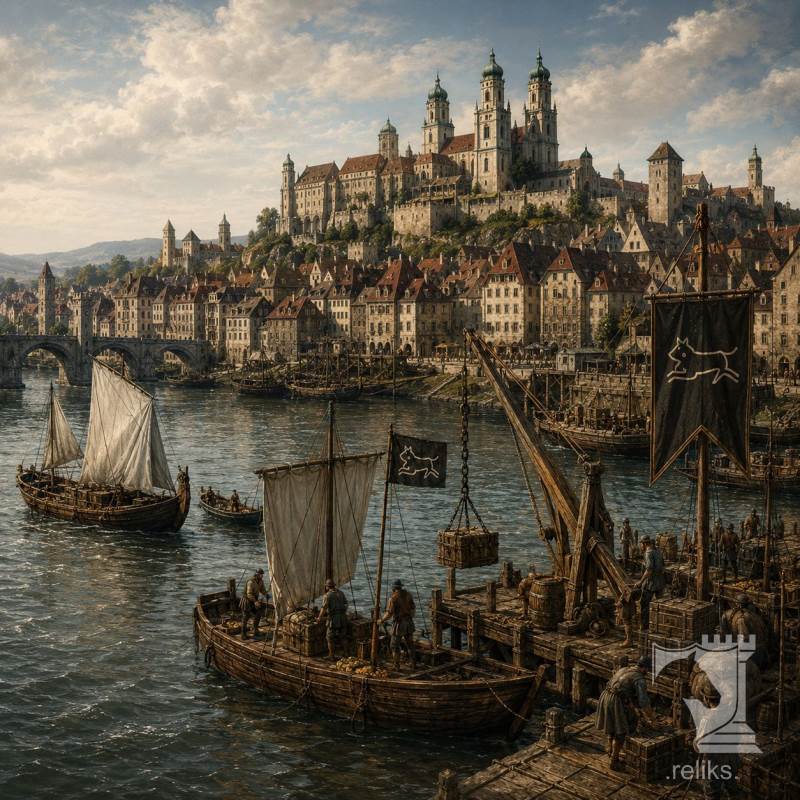
By the 13th century, Passau had become one of Europe’s most respected blade-manufacturing centres
The Rise of Passau as a Sword-Making Centre
The city of Passau lies in Bavaria, Germany, at the meeting point of the Danube, Inn, and Ilz rivers. During the medieval period, this location made Passau an important commercial crossroads linking Central Europe with eastern and northern trade routes. Goods flowed through the city by river, and among the most sought-after exports were swords.
By the 13th century, Passau had become one of Europe’s most respected blade-manufacturing centres. Water-powered hammer mills along the rivers allowed smiths to increase production while maintaining high standards of craftsmanship. Guild structures helped regulate quality and protect trade practices, while the authority of the Prince-Bishops of Passau provided political stability and economic influence.
The city’s swordsmiths developed a reputation for producing durable and reliable blades during an age when a weapon could determine survival on the battlefield. Unlike many medieval tools, swords were expensive prestige items. A high-quality blade represented status, military capability, and personal wealth. Buyers were willing to pay premium prices for blades associated with respected manufacturing centres.
Passau became one of those names.
As demand grew, Passau blades spread far beyond Bavaria. Surviving examples and historical references suggest that wolf-marked blades circulated throughout the Holy Roman Empire, Scandinavia, England, France, and parts of Eastern Europe. Some were mounted locally into regional hilt styles after importation, meaning a German blade might eventually appear in a Scandinavian or English sword.
This international trade helped transform the Passau wolf into one of the medieval world’s most recognizable blade symbols.
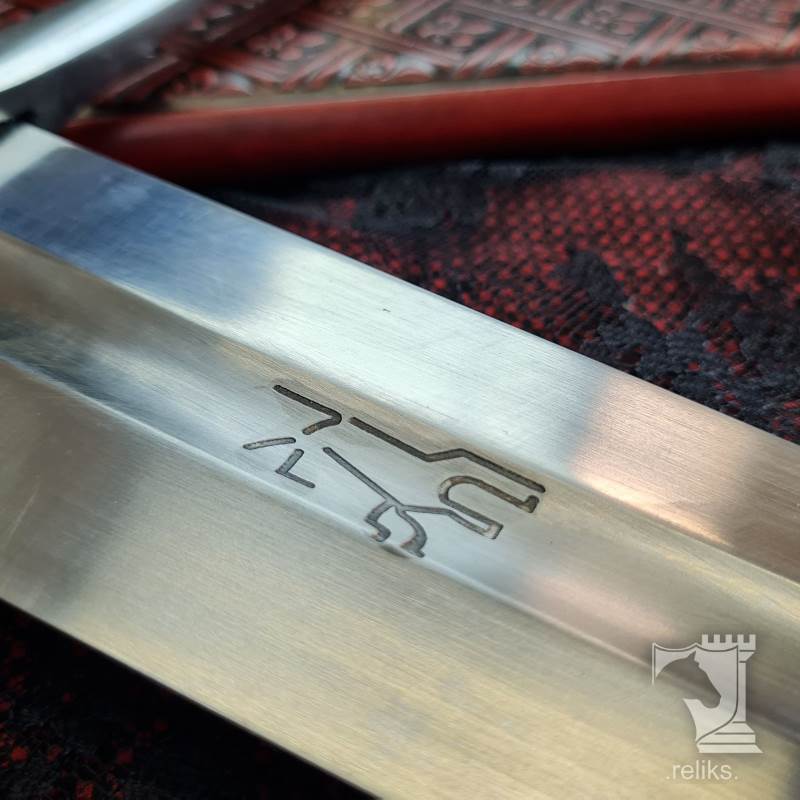
A 14th Century Passau Wolf Marking
The Origins of the Wolf Symbol
The exact origin of the Passau wolf mark remains debated among historians, but most researchers associate it with the heraldic imagery connected to the Prince-Bishopric of Passau. The wolf likely began as an official or semi-official symbol linked to the city’s sword-making industry and eventually became associated with the blades themselves rather than any single workshop.
Early wolf marks from the late 13th and 14th centuries are surprisingly recognizable as animals. They often feature visible legs, tails, elongated bodies, and distinct heads. Over time these shapes became increasingly stylized, eventually transforming into abstract arrangements of lines and curves.
Unlike modern trademarks, medieval marks were not governed by strict international intellectual property laws. Symbols evolved organically through workshops, apprenticeships, copying, and regional variation. The wolf became less important as a literal animal and more important as a recognizable sign of quality and reputation.
To medieval buyers, the symbol itself carried meaning. A warrior purchasing a sword marked with the Passau wolf was not simply buying sharpened steel. He was buying into a reputation built over generations.
Why Passau Blades Became Famous
The reputation of Passau blades was not accidental. Medieval sword buyers cared deeply about blade quality because a sword was both a costly investment and a survival tool. A poor-quality blade could bend, chip, or fail in combat.
Passau swordsmiths gained recognition for producing blades that combined flexibility, resilience, and effective heat treatment. While modern metallurgy has surpassed medieval methods, the best historical blades were highly sophisticated for their time. Skilled smiths understood how to forge and temper steel in ways that balanced hardness and durability.
The fame of Passau blades eventually spread through military use, merchant networks, and noble patronage. The wolf mark became a medieval symbol of trust. Much like modern consumers recognize prestigious manufacturers today, medieval buyers recognized the wolf.
The mark also developed a more symbolic and superstitious reputation. Throughout the Middle Ages, weapons were often viewed as objects carrying spiritual significance. Swords appeared in religious ceremonies, inheritance traditions, coronations, and heroic literature. Some historical references suggest that wolf-marked blades were believed by certain owners to carry protective qualities or bring fortune in battle.
Whether these beliefs were widespread or localized is difficult to prove conclusively, but they reflect the broader medieval tendency to associate symbols with divine favour and supernatural protection. In this sense, the Passau wolf existed both as a commercial mark and as a cultural symbol.
The Evolution of the Passau Wolf Mark
One of the most fascinating aspects of Passau wolf blades is the dramatic evolution of the mark itself. Over centuries, the wolf transformed from a recognizable animal into increasingly abstract and fragmented designs.
This evolution is so distinctive that historians sometimes use the appearance of the wolf to help estimate the age of surviving blades.
Early Wolves – 13th to 14th Century
The earliest known wolf marks are comparatively naturalistic. They often display four recognizable legs, a long tail, a distinct head, and compact body proportions.
These early wolves resemble simplified line drawings of actual animals. Even when stylized, the creature remains immediately identifiable as a wolf or canine figure. The marks from this period often appear confident and deliberate, suggesting they were intended to be clearly recognized by buyers and owners.
Transitional Wolves – 15th Century
By the 15th century, the wolf marks began changing dramatically. Bodies stretched into longer linear forms while limbs fragmented into angular strokes and disconnected segments. Some wolves from this period appear almost skeletal or geometric.
This transitional phase may reflect evolving artistic conventions, workshop copying, simplified engraving methods, or attempts by imitators to reproduce famous marks imperfectly. The 15th century also corresponds with a period of intense sword production across German-speaking regions, increasing the likelihood of regional variations.
Late Wolves – 16th to 17th Century
Later wolf marks become extremely abstract. In some examples, only a few lines remain to suggest the original animal form. Heads become simplified into angular wedges or hooked shapes while bodies turn into sweeping serpentine curves. Certain late examples barely resemble wolves at all unless compared directly with earlier forms.
To modern collectors, these late marks can appear mysterious or cryptic, but they are part of the same evolving visual tradition. The transformation of the wolf over centuries creates one of the most visually compelling stories in medieval arms history.
Medieval Counterfeiting and Imitation
Perhaps the strongest evidence of the Passau wolf’s reputation is the fact that other smiths copied it.
By the late Middle Ages and Renaissance period, imitation wolf marks had become widespread. Swordsmiths outside Passau realized the symbol carried commercial value. Adding a wolf mark to a blade could increase desirability and buyer confidence.
This phenomenon represents a remarkably early form of brand counterfeiting.
Not all copied wolves were necessarily intended as fraud. In some cases, regional workshops may have adopted wolf-inspired designs simply because the symbol had become associated with sword making itself. In other cases, however, the intention was likely to benefit directly from Passau’s established reputation.
Eventually, Solingen rose to prominence as Germany’s dominant blade-manufacturing centre, surpassing Passau in scale and influence. Yet even as industrial leadership shifted, the wolf mark remained culturally powerful enough to continue appearing on blades.
For modern historians and collectors, this creates an important challenge. Not every wolf-marked blade was necessarily made in Passau. Authenticating medieval swords requires examining blade geometry, hilt construction, metallurgy, inscriptions, decorative style, provenance, and the style of the wolf itself. The mark alone is rarely enough to confirm origin.
Passau Blades Across Europe
The spread of Passau blades across Europe reflects the interconnected nature of medieval trade and warfare.
German blades were highly respected internationally, and many regions imported unfinished blades before mounting them locally. This means a sword discovered in Scandinavia or England may still carry a German blade signature beneath a locally produced hilt.
Archaeological discoveries and museum collections show that Passau-marked blades travelled vast distances. Scandinavian collections in particular preserve examples of imported German blades, demonstrating the reach of Passau’s trade networks.
The popularity of imported blades also reflects the specialization of medieval industry. Not every region produced steel or sword blades of equal quality. In many cases, it was more practical to import respected blades than manufacture them locally.
The Passau wolf therefore represents not only sword craftsmanship, but also the movement of technology, trade, and cultural prestige across medieval Europe.
Reading the Marks Today
For collectors, one of the most exciting aspects of studying Passau wolves is learning how much information a small symbol can contain.
A faint engraving near the hilt might reveal an approximate production period, regional influences, workshop traditions, or signs of later imitation. Many historical marks are now worn from centuries of polishing, corrosion, sharpening, and restoration. Some are visible only under angled lighting or careful examination.
Others survive as partial fragments, leaving historians to compare surviving line structures against known examples.
This detective work is part of what makes historical sword collecting so compelling. The wolf mark becomes a surviving signature from the medieval world — a small surviving trace left by craftsmen who lived centuries ago.
The Legacy of the Passau Wolf
The Passau wolf remains one of the most famous blade marks in European sword history because it represents far more than decoration.
It symbolizes medieval craftsmanship, international trade, the rise of industrial reputation, collector fascination, and the enduring human desire to leave a mark upon history.
Long before modern corporations developed logos and branding strategies, the swordsmiths of Passau created a symbol recognized across Europe. The wolf became a guarantee of quality, a mark of prestige, and eventually a target for imitation.
Today, surviving wolf marks continue to fascinate historians, collectors, reenactors, and sword enthusiasts alike. Each variation tells part of a centuries-long story about the evolution of medieval arms production and the craftsmen who forged weapons that still capture the imagination hundreds of years later.
For modern collectors, the Passau wolf is more than a mark on steel. It is a direct connection to the medieval world.