What Is 1095 Cro-Van Steel? Why KA-BAR Still Trusts This Proven Knife Steel
Spend enough time looking at KA-BAR knives and one steel name keeps appearing: 1095 Cro-Van
.
It can be found on everything from classic military-inspired designs to hard-working outdoor knives, and it has been associated with KA-BAR for years.
At first glance, that might seem unusual. The modern knife market is filled with steels carrying impressive names and specifications.
Powder metallurgy steels such as CPM S35VN, CPM 20CV and MagnaCut receive plenty of attention, while steels such as Nitro-V and 14C28N
have become increasingly common on everyday carry knives. Against that backdrop, 1095 Cro-Van can sound decidedly old-school.
That isn't necessarily a disadvantage.
1095 Cro-Van belongs to a different school of knife design. Rather than chasing extreme edge retention or maximum corrosion resistance,
it offers a combination of toughness, straightforward sharpening and dependable cutting performance
that makes a great deal of sense for larger working knives.
That balance also helps explain why KA-BAR continues to use it.
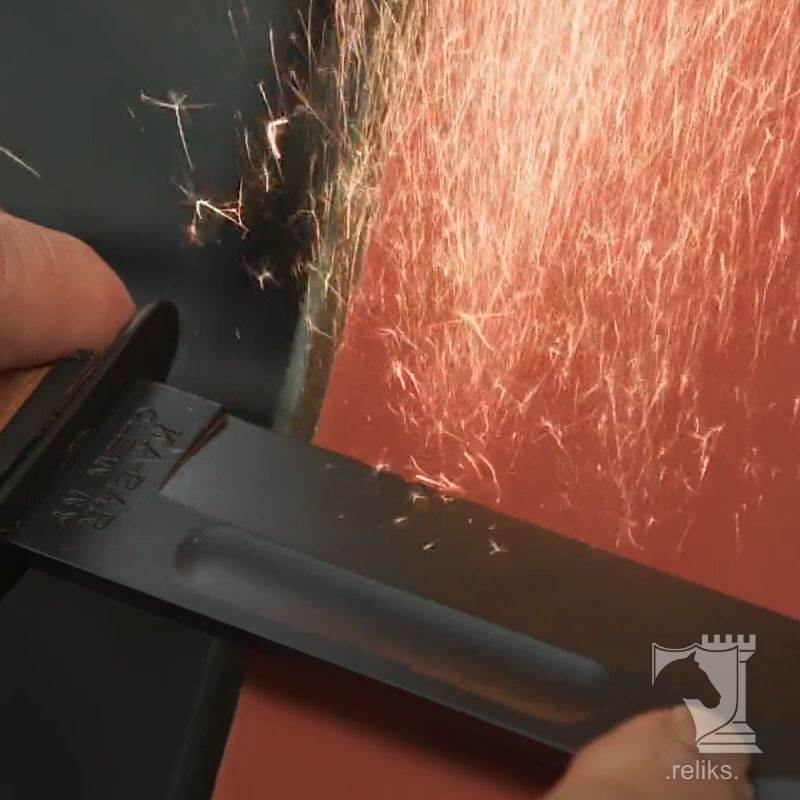
1095 cro-van Ka-bar knife being factory sharpened
What Is 1095 Cro-Van Steel?
1095 Cro-Van is a high-carbon steel closely related to traditional 1095 carbon steel, but with additional alloying elements used to modify its characteristics.
The "1095" portion of the name immediately gives experienced knife enthusiasts a clue about what to expect. Traditional 1095 is a simple high-carbon steel
that has been used for knives and other cutting tools for generations. It can take an excellent edge, responds well to proper heat treatment and is relatively easy to sharpen.
Cro-Van builds upon that basic idea.
The name refers to the addition of chromium and vanadium
, along with other elements in relatively small amounts.
These additions help distinguish 1095 Cro-Van from ordinary 1095 and contribute to the characteristics that have made it particularly useful for hard-working knives.
This is still very much a carbon steel, however. The chromium content should not lead anyone to mistake it for stainless steel.
There simply isn't enough chromium present to provide the level of corrosion resistance expected from a true stainless knife steel.
Think of 1095 Cro-Van as an enhanced version of the traditional high-carbon steel formula rather than an attempt to turn 1095 into a modern stainless steel.
What Is 1095 Cro-Van Made Of?
Exact published compositions can vary slightly depending on the source and specification, but 1095 Cro-Van is generally characterized by approximately 1% carbon
along with smaller additions of chromium, vanadium, manganese, silicon and other elements.
The carbon is particularly important. Its relatively high carbon content allows the steel to achieve the hardness necessary for a good cutting edge when it is properly heat treated.
Chromium contributes to hardenability and wear characteristics, while vanadium can help refine the grain structure and contributes to the formation of hard carbides.
Manganese and silicon also play supporting roles in the steel's performance and manufacturing characteristics.
For the knife owner, though, the precise percentages aren't nearly as important as what the complete recipe accomplishes after proper heat treatment.
And that brings up an important point about knife steels in general: the name stamped on the blade is only part of the story.
Heat treatment, blade geometry, edge geometry and the intended purpose of the knife can have just as much influence on real-world performance as the steel itself.
1095 Cro-Van vs 1095 Steel
Because the names are so similar, 1095 and 1095 Cro-Van are sometimes treated as though they are exactly the same material. They are related, but that isn't quite accurate.
Traditional 1095 is a comparatively simple carbon steel. Its simplicity is part of its appeal. With proper heat treatment it can produce a tough, sharp and dependable blade
without requiring an exotic alloy recipe.
1095 Cro-Van takes that familiar foundation and modifies it with additional alloying elements, most notably chromium and vanadium.
The result isn't a completely different class of steel. Both still share many of the characteristics people associate with traditional carbon-steel knives.
Both can take keen edges, both can be relatively easy to sharpen, and neither should be treated as stainless.
The differences are better thought of as refinements.
For someone shopping for a knife, there is little reason to view 1095 Cro-Van simply as "regular 1095 with a fancier name."
The alloy and, importantly, the manufacturer's heat treatment should be considered as part of the complete blade.
That last point is particularly relevant when talking about KA-BAR.
Why Does KA-BAR Use 1095 Cro-Van?
KA-BAR and 1095 Cro-Van have become closely associated because the characteristics of the steel fit the types of knives for which the company is particularly well known.
Many KA-BAR designs aren't small gentleman's folders intended primarily for opening envelopes and packages.
The company's heritage includes substantial fixed blades, outdoor knives and utility designs expected to perform under demanding conditions.
For these applications, toughness matters.
Extreme wear resistance can sound impressive on a specification sheet, but there is always a trade-off.
A steel engineered primarily to hold an edge for an exceptionally long time isn't automatically the ideal material for every type of blade.
A larger fixed blade may encounter impacts, twisting forces and rougher use than a typical pocket knife.
In that environment, a sensible balance between hardness and toughness can be more useful than simply maximizing edge retention.
1095 Cro-Van also has another very practical advantage: it is relatively easy to sharpen.
That matters on a working knife. A blade that has seen significant use can generally be brought back to a sharp edge without requiring specialized sharpening equipment
or a lengthy session at the sharpening bench.
Put those characteristics together and KA-BAR's continued use of the steel begins to make considerably more sense.
Is 1095 Cro-Van Tough?
Toughness is one of the major reasons 1095 Cro-Van remains relevant.
In knife terminology, toughness refers to a steel's ability to resist damage such as cracking or chipping when subjected to stress or impact.
It shouldn't be confused with hardness or edge retention.
A very hard steel can have excellent wear resistance while being less tolerant of impacts. Conversely, a steel optimized for toughness may give up some wear resistance
in exchange for being more forgiving under demanding use.
1095 Cro-Van sits firmly on the practical side of that equation.
When combined with appropriate heat treatment and blade geometry, it is well suited to the sort of substantial fixed blades for which KA-BAR is known.
This doesn't mean a 1095 Cro-Van knife is indestructible. No knife steel is. Blade thickness, grind, edge angle, heat treatment and how the knife is being used all matter.
What it does mean is that toughness is an important part of the steel's appeal.
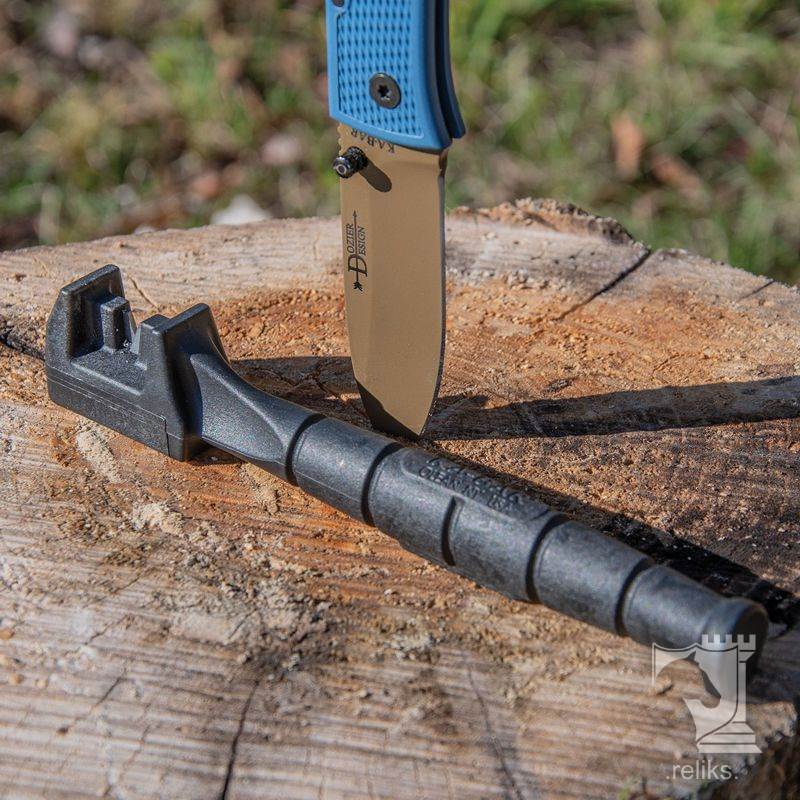
easy to sharpen in the field with a small sharpening stone or light weight sharpening tool
How Well Does 1095 Cro-Van Hold an Edge?
Edge retention is good for the intended role of the steel, but this isn't the category where 1095 Cro-Van is trying to compete with today's high-wear-resistance powder steels.
A premium modern steel such as CPM 20CV can generally offer substantially greater wear resistance.
That can translate into longer periods between sharpening under certain types of cutting.
But there is another side to that equation.
The more wear-resistant a steel becomes, the more effort it can require to sharpen.
1095 Cro-Van takes a more traditional approach: useful edge retention combined with comparatively easy edge maintenance.
For an outdoor or general-purpose working knife, that can be a very desirable compromise.
Instead of asking only, "How long will this knife stay sharp?" it is often more useful to ask,
"What happens when it finally becomes dull?"
With 1095 Cro-Van, getting the edge back usually isn't a major undertaking.
Is 1095 Cro-Van Easy to Sharpen?
For many owners, this is one of its strongest characteristics.
1095 Cro-Van responds well to conventional sharpening methods and doesn't require exotic abrasives simply to restore a useful edge.
Someone accustomed to maintaining traditional carbon-steel knives should find the experience familiar.
This can be especially useful for an outdoor knife.
A working blade may be sharpened many times throughout its life. Easy maintenance becomes increasingly valuable when the knife is viewed as a long-term tool
rather than something that needs to win a specification-sheet comparison.
There is also something satisfying about a knife that can be maintained without much fuss.
When an edge starts losing its bite, a reasonable sharpening session can put it back to work.
Does 1095 Cro-Van Rust?
Yes. This is probably the most important limitation for a new owner to understand.
1095 Cro-Van is not stainless steel.
Although chromium is present in the alloy, there isn't enough to provide the corrosion resistance associated with stainless steels such as 14C28N, Nitro-V, S35VN or 20CV.
If the exposed steel is left wet or subjected to humid conditions without care, corrosion can occur.
This is one reason many KA-BAR 1095 Cro-Van blades feature protective coatings.
A coating reduces the amount of exposed steel and provides an additional barrier against moisture.
The cutting edge remains exposed, however, and coatings can eventually wear through in areas that see repeated contact.
Fortunately, caring for 1095 Cro-Van isn't particularly complicated. Keeping the blade clean and dry and applying an appropriate light protective oil when needed
goes a long way toward preventing corrosion.
Owners living near salt water or using a knife regularly in wet environments simply need to pay more attention than they would with a highly corrosion-resistant stainless steel.
How Hard Is 1095 Cro-Van?
KA-BAR commonly heat treats its 1095 Cro-Van blades to a hardness appropriate for the intended knife rather than pushing the steel toward the highest possible Rockwell number.
This distinction matters.
It is tempting to assume that a higher HRC number automatically means a better knife. In reality, hardness is another balancing act.
Increasing hardness can improve certain aspects of edge performance, but pushing a steel too far can come at the expense of toughness.
For the larger fixed blades associated with KA-BAR, a slightly more forgiving heat treatment can make a great deal of sense.
The goal isn't to produce the hardest blade possible.
The goal is to produce a blade that performs properly.
Is 1095 Cro-Van an Outdated Knife Steel?
This is perhaps the most interesting question surrounding 1095 Cro-Van.
By modern knife-industry standards, it certainly isn't exotic. It doesn't require powder metallurgy, doesn't offer extraordinary corrosion resistance
and won't dominate a chart comparing pure wear resistance.
But calling it outdated assumes that every new steel is automatically better for every knife.
That isn't how knife design works.
Consider the difference between a compact folding knife and a substantial outdoor fixed blade.
The folder may spend most of its life cutting cardboard, tape, plastic packaging and other relatively predictable materials.
High edge retention and corrosion resistance can be extremely attractive.
A larger outdoor knife may have a very different job.
Toughness, ease of sharpening and resistance to edge damage can become much more important.
The ability to maintain the knife easily also carries more weight.
Viewed from that perspective, 1095 Cro-Van doesn't seem particularly outdated at all.
It is simply optimized around a different set of priorities.
1095 Cro-Van vs Modern "Super Steels"
Comparing 1095 Cro-Van directly with steels such as MagnaCut, CPM S35VN or CPM 20CV can be useful, but only if the comparison includes the intended knife.
Modern powder steels can offer impressive combinations of edge retention, corrosion resistance and toughness. Metallurgy has unquestionably advanced.
But those advantages often come with increased material costs, manufacturing complexity and sometimes more demanding sharpening.
More importantly, a steel cannot be separated from the knife built around it.
Putting an expensive high-wear-resistance steel into a large fixed blade doesn't automatically make that knife superior.
Likewise, using 1095 Cro-Van in a small premium EDC folder where corrosion resistance and extended edge retention are priorities
might not take advantage of its greatest strengths.
Steel selection is part of knife design, not a scoreboard.
That is why comparing steels purely by price or specifications can sometimes be misleading.
Is 1095 Cro-Van Good for Outdoor Knives?
This is arguably where the steel makes the most sense.
A good outdoor knife needs to perform reliably without becoming unnecessarily difficult to maintain.
1095 Cro-Van offers enough edge retention for serious cutting while remaining relatively straightforward to sharpen.
Its toughness is particularly attractive for larger blades.
The main consideration is moisture. Anyone carrying a carbon-steel knife outdoors needs to remember that rain, humidity and condensation can all promote corrosion.
A coated blade greatly reduces the amount of exposed steel, but basic maintenance is still worthwhile.
For someone comfortable looking after a carbon-steel blade, that is a relatively small trade-off.
The KA-BAR Connection
Few companies are as closely associated with this steel as KA-BAR
.
The company's traditional fighting and utility knives helped establish a reputation for rugged fixed blades, and 1095 Cro-Van has become part of that identity.
The steel can be found across numerous KA-BAR designs, including knives intended for outdoor, military-inspired and general utility applications.
It also appears throughout designs associated with KA-BAR's Becker line, where substantial blades and outdoor use make the characteristics of 1095 Cro-Van particularly appropriate.
This gives shoppers an interesting way to look at KA-BAR's steel choice.
The company isn't necessarily using 1095 Cro-Van because more modern steels don't exist. KA-BAR itself has produced knives using numerous other steels.
Instead, the continued presence of 1095 Cro-Van suggests that there are applications where its particular combination of properties still works extremely well.
Sometimes proven performance is more valuable than novelty.
Who Is 1095 Cro-Van Best For?
1095 Cro-Van makes the most sense for someone who values a knife as a practical cutting tool and doesn't mind performing basic maintenance.
It is particularly well suited to fixed blades where toughness and easy sharpening matter more than extreme edge retention.
That can be especially valuable for backcountry campers, hunters and wilderness travellers on extended trips
,
where a full sharpening setup isn't practical to carry. Being able to restore a useful edge with simple field sharpening equipment is a genuine advantage.
The same practicality has long appealed to military personnel and others who rely on their equipment in the field
.
Toughness, reliability and straightforward sharpening have helped steels like 1095 Cro-Van remain relevant even as more advanced alloys have become available.
Someone who wants maximum corrosion resistance may be happier with stainless steel, while a user focused primarily on extended edge retention may prefer a modern high-wear-resistance steel.
For a dependable working knife that can be maintained almost anywhere, however, 1095 Cro-Van remains a very practical choice.
Is 1095 Cro-Van a Good Knife Steel?
Absolutely — when it is used for the right knife.
1095 Cro-Van isn't trying to be the latest super steel. Its strengths are much more straightforward:
good toughness, a keen cutting edge, easy sharpening and proven performance in hard-working knives.
Its biggest weakness is equally straightforward. It isn't stainless and requires more attention to corrosion prevention than modern stainless steels.
For many knife owners, particularly those looking at substantial KA-BAR fixed blades, that is a reasonable trade.
There is a reason this steel continues to appear on knives decades into an era increasingly dominated by sophisticated stainless and powder-metallurgy alloys.
The requirements of a good working knife haven't changed simply because metallurgy has advanced.
A blade still needs to cut. It needs to survive the work it was designed to perform.
And when the edge eventually becomes dull, it needs to be sharpened and put back into service.
1095 Cro-Van does those things remarkably well.
That may not make it the newest steel in the knife case, but it goes a long way toward explaining why KA-BAR continues to trust it.