Kogai and Kozuka: The Hidden Utility Pair in Japanese Sword Mountings
Japanese swords are often admired for their blades, lacquered saya, and beautifully worked fittings, but some of the most fascinating details in a complete koshirae are also the easiest to overlook. Tucked neatly into the side of the saya, often so elegantly integrated that modern enthusiasts barely notice them at first glance, are two of the most refined accessories in Japanese sword furniture: the kogai
and the kozuka
.
To the untrained eye, they can look like small decorative additions. To collectors, they are something far more interesting. These slim fittings reveal how Japanese sword mountings balanced beauty, utility, etiquette, and craftsmanship in ways that few other sword traditions ever attempted. In some examples they served practical purposes. In others, they became canvases for master metalworkers, transformed into miniature works of art that matched the broader visual language of an entire mounting.
They also open the door to one of the more fascinating aspects of Japanese sword collecting
: the fact that some of the most important details on a sword are not always the blade itself, but the quiet, carefully considered objects mounted beside it. For collectors who enjoy studying the finer points of koshirae, the kogai and kozuka are exactly the kind of details that reward a closer look.
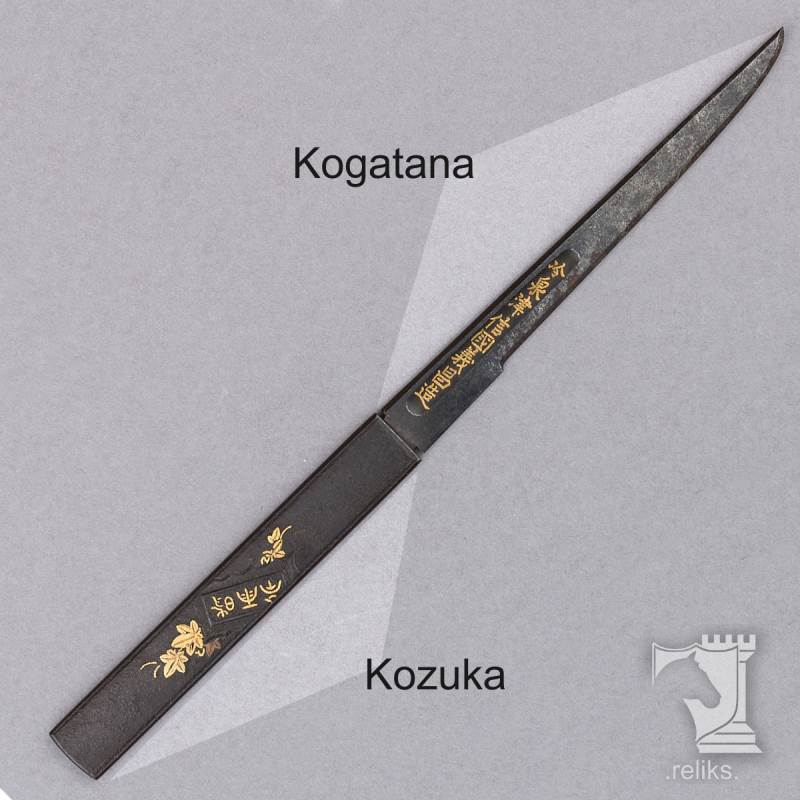
Kozuka with mounted kogatana*
A Collector’s Note on the Terms
Japanese sword furniture has a way of rewarding close attention, and the terms kogai
, kozuka
, and kogatana
are a perfect example. Many collectors casually refer to the small side knife in the saya as a kozuka
, but that is only partly correct. Strictly speaking, the kozuka
is the decorated handle of the small utility knife, while the blade fitted into it is the kogatana
. When both survive together, museum catalogues often describe the piece as a kozuka with blade
, which is a useful reminder that the ornate fitting and the working blade were distinct parts of the same accessory.
The kogai
is something else entirely. It is not a knife, but a separate implement usually mounted in the opposite side of the saya. It is most often described as a grooming or personal utility tool, though its exact everyday use has been interpreted in different ways over time. That slight uncertainty only adds to the appeal. It reminds us that Japanese swords were once carried in a living culture where the meaning of these objects would have been far more familiar than it is today.
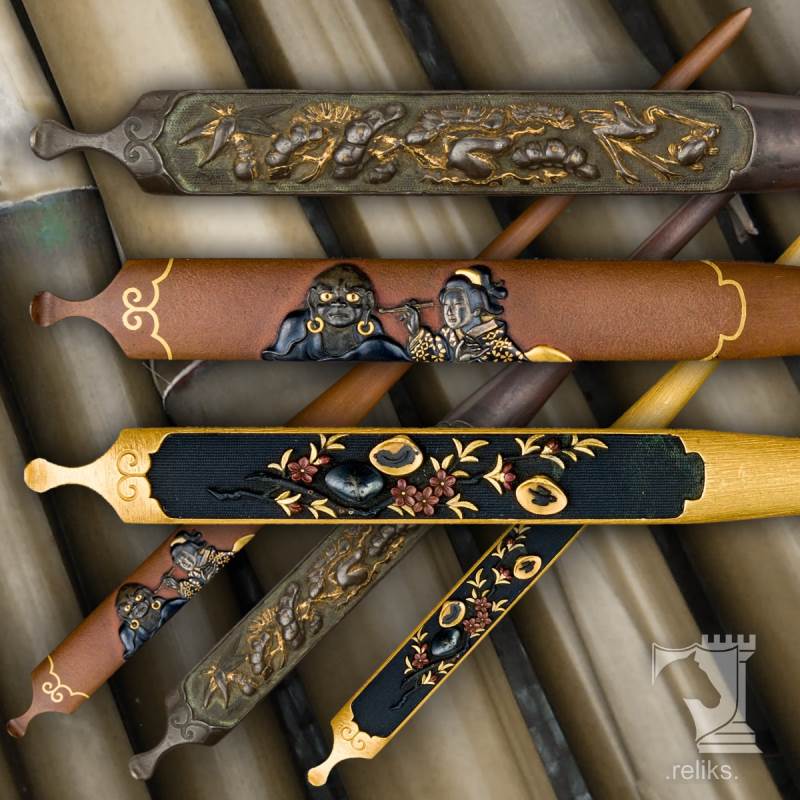
Antique, original kogai utility pieces*
What Is a Kogai?
The kogai
is a slender metal implement mounted into a dedicated slot in the side of the saya
. At first glance, it can resemble a hairpin, skewer, or narrow decorative rod, often with a widened ornamental head that echoes the style of the sword’s other fittings. In many surviving examples, the visible end is richly decorated with inlay, relief carving, nanako texture, or motifs that match the fuchi-kashira, menuki, and kozuka.
Most museum descriptions identify the kogai as a hairdressing or personal grooming implement
, and that remains the safest and most widely accepted description today. In practical terms, it appears to have belonged to the broader world of personal accessories and daily etiquette rather than functioning as a weapon in its own right. Like many features of Japanese sword furniture, however, it evolved far beyond pure utility. By the Edo period in particular, the kogai was often treated as part of a coordinated artistic ensemble, valued as much for its decorative quality and symbolic harmony as for any practical role it may once have served.
For collectors, that is part of what makes the kogai so intriguing. It is an accessory that seems simple until you begin noticing how carefully it was integrated into the sword’s overall design. On a high-quality koshirae, it is rarely random. The motif, metalwork, and finish often tie directly into the larger visual identity of the mounting.
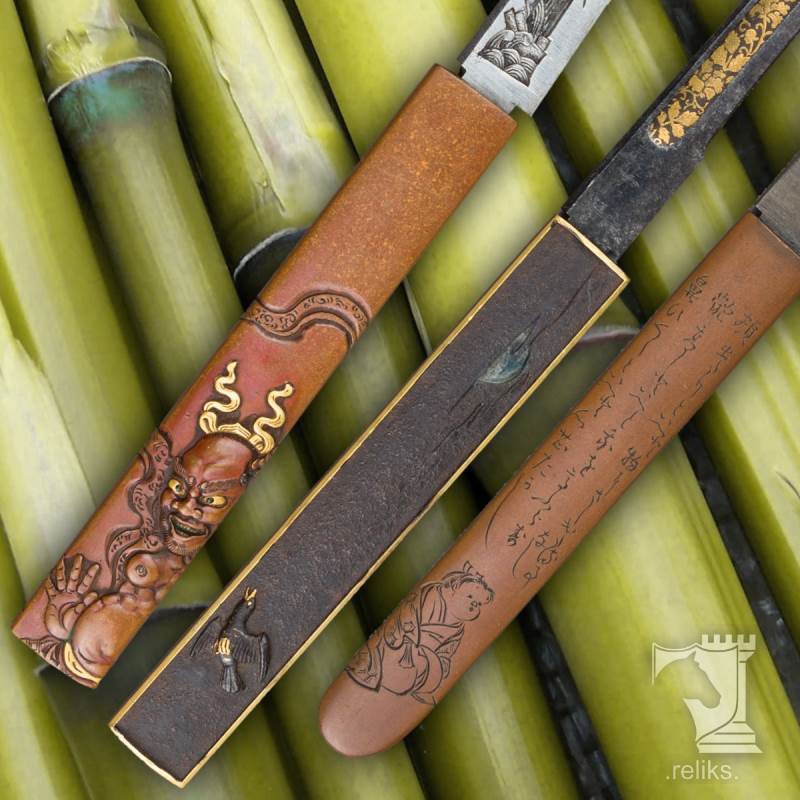
Antique Kozuka mounted to blades (kogatana)*
What Is a Kozuka?
The kozuka
is the decorated handle of the small utility knife carried in the saya
. Fitted into it is a small blade called the kogatana
, together forming the compact by-knife associated with many traditional Japanese sword mountings. This is one of the most distinctive details of complete koshirae, and one of the most misunderstood by modern enthusiasts.
Because the handle is the visible and decorative part, the word kozuka
is often used informally to describe the entire small knife. In technical terms, however, the distinction matters. The ornate fitting is the kozuka. The blade is the kogatana. Together, they form the complete small side knife carried in the saya.
In collecting terms, the kozuka often steals the show. The handle is frequently much more elaborate than the blade itself, because it was the portion meant to be seen and appreciated. Many kogatana blades are relatively plain, practical, and sometimes replaced over time, while the kozuka handle can be exquisitely worked with precious alloys, gold and silver accents, or fine carving that mirrors the artistic themes of the sword’s other fittings.
This dual nature is part of the appeal. The kozuka is both useful and ornamental, functional and deeply aesthetic. It is one of the clearest examples of how Japanese sword mountings elevated even a humble tool into a deliberate artistic statement.

Kogai fitted into the saya
Where They Sit in the Saya
One of the easiest ways to understand the pair is to picture the saya (scabbard)
not simply as a sheath, but as a carefully designed housing for multiple accessories. On many mountings, the saya includes narrow side openings specifically made to receive these pieces.
The kozuka
sits in a slot known as the kozuka-hitsu
, with the decorated handle exposed so it can be grasped and removed. The kogai
occupies its own opposing slot, often referred to as the kogai-hitsu
. When both are present, the sword takes on a particularly complete and balanced appearance, with each side of the saya visually answering the other.
This symmetry is part of the appeal. Even before a collector studies the motifs or materials, the mere presence of both fittings gives a mounting a sense of completeness and refinement. A Japanese sword fitted with both a kogai and a kozuka often feels more deliberate, more elegant, and more representative of the full sophistication of traditional koshirae design.
It is also worth noting that not every mounting includes both. Some may have only a kozuka, some neither, and others may have openings that are later left empty. This is one reason why complete, well-matched examples are so appreciated. When the pair survives together and clearly belongs to the mounting, the sword becomes much more than a blade in a sheath. It becomes a carefully composed object.
From Practical Tools to Artistic Statements
Like many elements of Japanese sword furniture, the kogai and kozuka appear to have roots in utility but achieved their highest expression as art. This is especially true in the Edo period, when sword mountings increasingly became vehicles for status, taste, and personal expression.
The practical side is easy enough to imagine. A small by-knife is a sensible accessory. A slim personal tool carried in the saya also fits naturally within the world of premodern daily dress. Yet in surviving high-end examples, what stands out is not simple practicality. It is artistry. Surfaces are carved with seasonal motifs, animals, warriors, mythological scenes, crests, waves, bamboo, dragons, or poetic landscapes. Precious metal overlays and subtle texturing turn these small fittings into miniature works of sculpture.
This transformation is one of the most rewarding things for collectors to study. The kogai and kozuka occupy a fascinating middle ground between tool
and treasure
. They are reminders that Japanese swords were not only weapons, but complete aesthetic systems. Every visible element could carry meaning. Every surface could be composed. Even the accessories tucked into the side of the saya were treated with the same seriousness as the tsuba or fuchi-kashira.
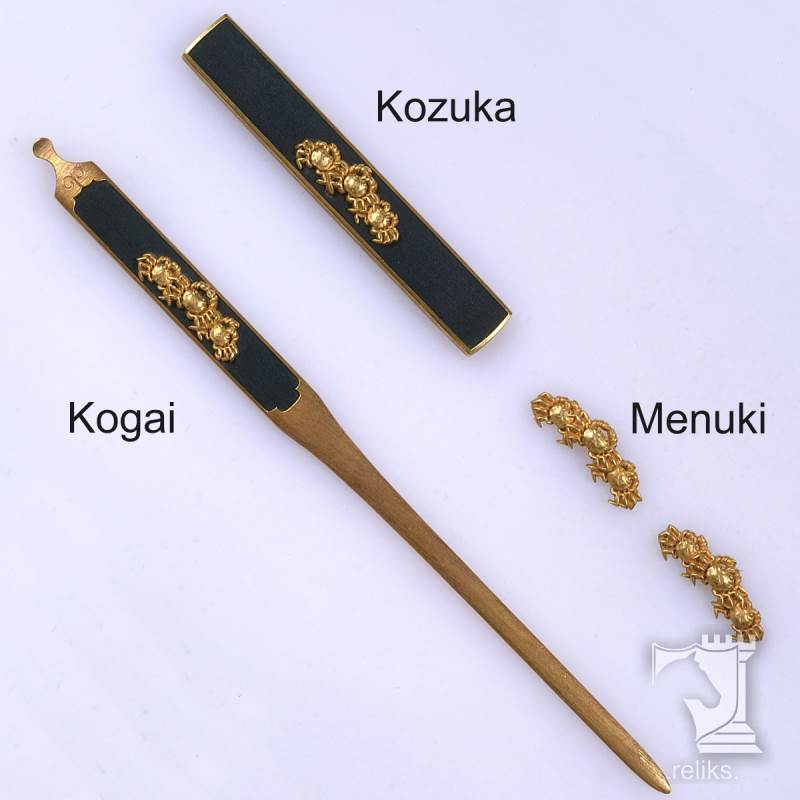
Antique mitokoromono set including matching menuki
The Relationship to Mitokoromono
For collectors who enjoy the finer details of Japanese fittings, the kogai and kozuka lead naturally into one of the most important terms in the field: mitokoromono
.
A mitokoromono
is a coordinated set of three fittings traditionally consisting of a kozuka
, a kogai
, and a pair of menuki
. These sets were often made as matching or thematically unified ensembles, sometimes by highly regarded schools of metalworkers, and they represent one of the most refined expressions of harmony in Japanese sword furniture.
This matters because it changes how you look at a sword. A collector who notices only the tsuba may miss much of the story. Once you begin studying the kogai, kozuka, and menuki together, a mounting starts to reveal intention. Repeated motifs, seasonal symbolism, family crests, literary references, or visual contrasts suddenly make sense as part of a complete design rather than as isolated decorative touches.
In that sense, the kogai and kozuka are not merely side accessories. They are often key participants in the sword’s visual identity.
Materials, Schools, and the Art of Miniature Metalwork
Some of the most beautiful kogai and kozuka ever made came from the same tradition of master metalworkers responsible for the finest Japanese sword fittings. Depending on the period and school, these pieces may be found in shakudo
, shibuichi
, copper alloys, iron, silver, or mixed-metal combinations with gold and silver inlay.
Collectors often encounter nanako punched grounds, high-relief carving, coloured metal accents, gilt details, fine engraving, and carefully patinated surfaces that create subtle tonal depth. On high-level examples, the amount of artistic control is remarkable. These are small objects, but they carry an extraordinary amount of visual information.
A tiny kozuka handle may present an entire landscape scene, a warrior in motion, or a dragon twisting through clouds, all within a space small enough to sit comfortably in the hand. A kogai may appear understated at first, only to reveal exquisitely balanced ornament and surface treatment on close inspection. This is one reason serious enthusiasts often develop a fascination with kodogu
in general. Once you realise how much artistry is packed into these miniature fittings, it becomes easy to understand why many collectors study them almost as passionately as blades.
Why Collectors Sometimes Confuse Them
It is very common for newer collectors to mix up the terms, and that is understandable. The pieces are small. They sit in the same general area of the saya. Museum records are not always perfectly consistent. Dealers and auction listings may simplify terminology for broader audiences.
The most common point of confusion is the kozuka
, because the decorative handle is so visually dominant that many people use the term for the entire small knife. In casual conversation, this is not unusual. In more precise collecting language, however, the distinction between kozuka
and kogatana
is worth understanding.
The kogai
creates a different sort of confusion because modern viewers naturally assume it must be a blade or spike. In fact, it belongs to a different category of accessory altogether. Once you know that, the pair becomes much easier to recognise.
For many collectors, learning these small distinctions is part of the pleasure. Japanese sword study is full of terms that become clearer the longer you look. The kogai and kozuka are perfect examples of how a little precision can deepen appreciation without taking away any of the mystery.
Why Modern Reproductions Often Leave Them Out
Many modern reproductions, even otherwise attractive ones, omit the kogai and kozuka entirely. There are practical reasons for that. These accessories add complexity to the saya, require additional fitting work, and introduce parts that must be properly seated, aligned, and finished. If they are made poorly, they can feel gimmicky rather than elegant.
Historically inspired or higher-end reproductions sometimes include them, but even then, they are often simplified. The challenge is that a proper kogai and kozuka are not merely decorative inserts. They need to look integrated, proportionate, and believable within the mounting. If the fit is clumsy or the motifs do not match the rest of the koshirae, the illusion breaks immediately.
That is part of why original examples are so rewarding to study. On a well-made antique mounting, these accessories rarely feel like afterthoughts. They belong. Their proportions, finish, and visual rhythm are part of the sword’s overall composition. Once you have handled or closely studied a few good examples, you begin to understand why they are so admired.
What to Look For as a Collector
For collectors studying antique Japanese fittings or complete mountings, the kogai and kozuka offer several clues about quality, originality, and harmony.
Look first at whether the motif matches the rest of the koshirae. Repeated themes between the kozuka, kogai, menuki, and fuchi-kashira can suggest a more intentional and unified set. Pay attention to fit as well. A good kozuka should sit naturally in its slot, and a kogai should feel proportionate and properly finished rather than forced. If the kogatana
blade is still present, that can add another layer of interest, since many kozuka survive without it.
Materials and patina are also worth studying closely. A mismatched surface tone, uneven wear pattern, or jarring difference in quality can suggest later substitutions. Just because a Japanese sword has both fittings does not always mean they were born together. Matching workmanship and visual rhythm matter.
For collectors, these details are deeply satisfying. They turn a quick glance into a deeper reading of the object, and that is one of the great pleasures of Japanese sword collecting.
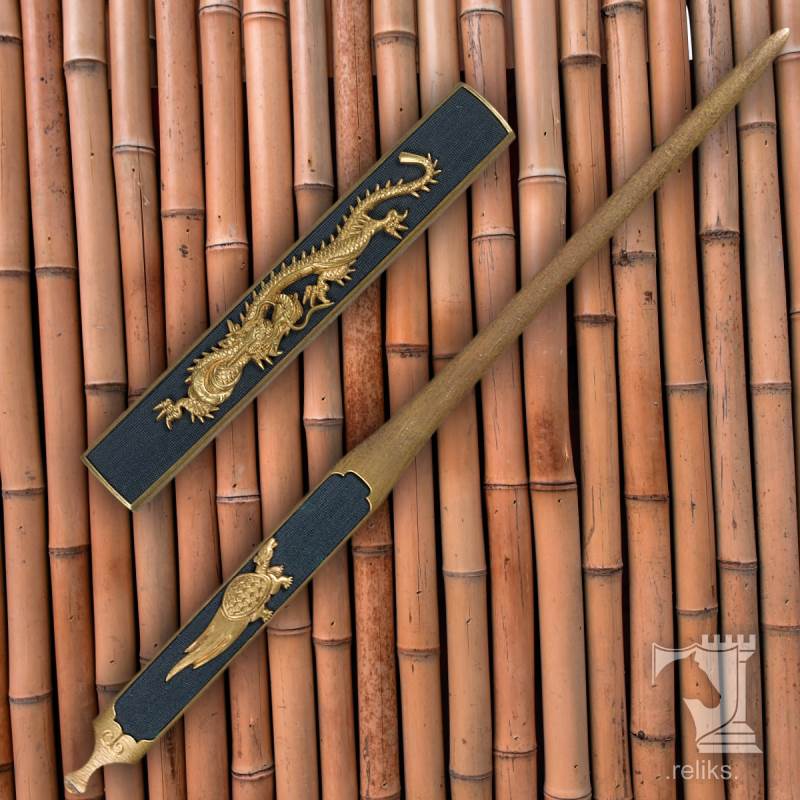
Antique set of Kogai and Kozuka (without blade)*
Small Details, Big Story
The kogai and kozuka are easy to overlook beside a dramatic tsuba or a beautifully forged blade, but that is precisely what makes them so rewarding. They are the sort of details that transform a sword from a weapon into a complete cultural object.
One is a slim accessory most often described as a grooming or personal utility tool. The other is the decorated handle of a small by-knife, paired with its kogatana blade. Together, they speak to a world in which even the smallest components of a sword mounting could be considered, refined, and elevated into art.
For collectors, they offer something special: the chance to notice what others miss. Once you begin paying attention to them, you start seeing Japanese swords differently. The sword is no longer just blade, guard, and saya. It becomes a complete design language, where every small fitting carries history, function, and intention.
That is one of the great rewards of studying Japanese sword mountings. The deeper you look, the more the quiet details begin to speak.
*Images marked with an asterisk are historical reference images sourced from public-use museum or public-domain collections, including The Metropolitan Museum of Art Open Access collection.