The Habaki: The Hidden Lock of the Japanese Sword
Small, quiet, and often overlooked, the habaki may be the most underestimated fitting on the Japanese sword. To the casual eye it appears to be a simple metal collar at the base of the blade. To collectors and craftsmen, it is something far more important: a precisely made mechanical interface that helps lock the blade into the scabbard, stabilise the mounting, and preserve the harmony of the sword as a complete system. While the tsuba, menuki, and other decorative fittings often attract the most attention, the habaki is the subtle component that makes the whole sword work as intended.
Among the many specialised fittings of the Japanese sword, few are as deceptively simple as the habaki. Positioned at the base of the blade just above the tang, this metal collar is essential to how a traditionally mounted sword seats, draws, and rests within its saya. It helps secure the blade at the koiguchi, supports the pressure and alignment of the seppa and tsuba, and forms one of the most exacting custom-fitted parts of the entire mounting. Without a properly made habaki, even a fine blade can feel loose, awkward, or mechanically wrong.
Because it is small and usually restrained in appearance, the habaki is often dismissed as a minor accessory. In reality, it is one of the most technically important parts of the Japanese sword. A good habaki is not a generic sleeve. It is made to the exact geometry of an individual blade, fitted to the ha-machi and mune-machi, shaped to the taper at the base, and sometimes even adjusted to account for features such as a hi. It is part lock, part spacer, part structural interface, and part evidence of a sword’s history. For collectors, it offers one of the clearest examples of how Japanese sword furniture unites engineering with elegance.
A well-made habaki is one of the most understated but essential parts of the Japanese sword, quietly locking blade, guard, and scabbard into harmony.
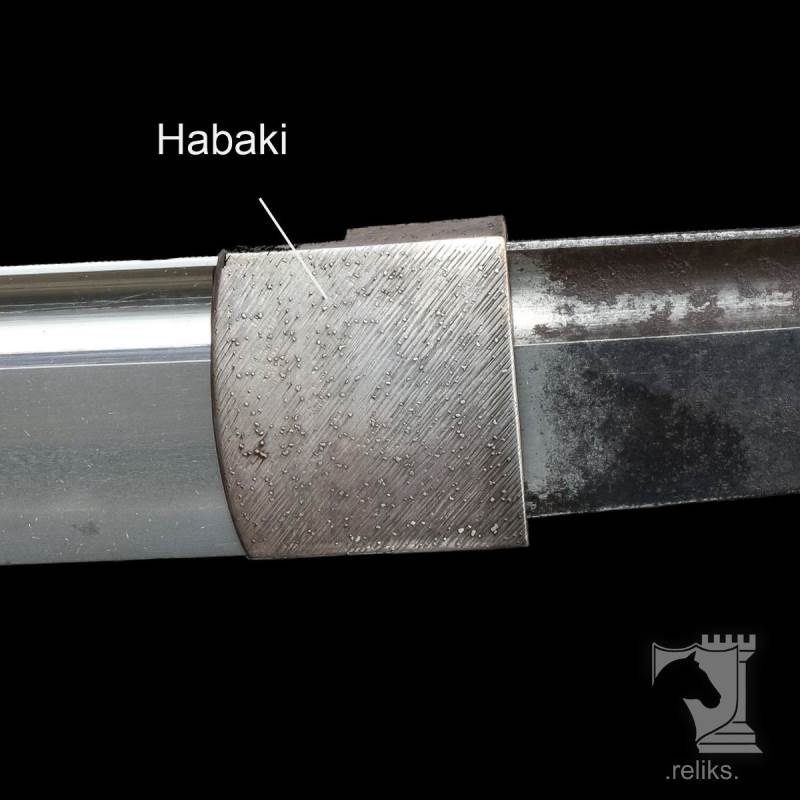
metal collar fitted around the base of a Japanese sword blade*
What Is a Habaki?
The habaki is the wedge-shaped metal collar fitted around the base of a Japanese sword blade, just above the tang and below the shoulders of the blade known as the machi. It sits at the point where the blade transitions into the mounted furniture and forms the forward anchor of the sword’s mounting assembly. When the sword is fully assembled, the habaki presses against the seppa and tsuba, helping maintain tension through the entire stack of fittings before the tsuka is secured in place.
Its most widely recognised role is to help the blade seat securely into the saya. The habaki is designed to engage the koiguchi, the mouth of the scabbard, creating a precise friction fit that holds the sword safely in place when sheathed. This is why the sword does not simply rely on gravity or the pressure of the guard to remain seated. The secure, controlled feeling of a properly mounted Japanese sword begins at the habaki and koiguchi interface.
In practical terms, the habaki is what transforms a blade into a mounted weapon that can be worn, drawn, and carried with confidence. Without it, the sword would not seat correctly, the guard assembly would lack proper support, and the relationship between blade and saya would be compromised. Although it is rarely the most decorative fitting on the sword, it is one of the most indispensable.
The habaki sits at the base of the blade and must fit with precision. Even slight errors can affect how the sword seats in the saya and how securely the mounting assembly is tensioned.
The Hidden Lock Between Blade and Saya
Many brief descriptions of the habaki stop at saying it “holds the blade in the scabbard.” While true, that explanation does not fully capture its importance. A properly made habaki is better understood as the sword’s hidden locking mechanism. It is the component that allows the blade to seat firmly at the koiguchi while still drawing cleanly when needed. The subtle resistance felt when drawing a properly mounted Japanese sword is not accidental. It is the result of a carefully matched habaki and scabbard mouth working together.
This is one of the great engineering refinements of the Japanese sword. The blade is not clamped by crude pressure along its full length, nor is it held by loose furniture at the hilt. Instead, the sword is retained at a precise point near the base of the blade. This allows the rest of the blade to rest safely within the saya while minimising unnecessary friction and wear. The system is elegant, controlled, and highly efficient.
For collectors who handle antique swords, this is one of the easiest things to feel and one of the hardest things to explain. A sword with a well-fitted habaki tends to seat with quiet confidence. A sword with a poor or mismatched habaki may rattle, bind, sit too loose, or feel wrong during drawing and re-sheathing. In that sense, the habaki is not simply part of the sword’s furniture. It is part of the sword’s behaviour.
More Than a Collar: How the Habaki Supports the Entire Mounting
The habaki does more than engage the koiguchi. It also plays a crucial structural role in the mounted assembly of the sword. When the sword is assembled, the habaki bears against the seppa and tsuba, helping establish the forward pressure that keeps the fittings tight and properly aligned. This is part of why a Japanese sword can maintain a compact, coherent mounting system despite the presence of multiple separate components.
In this way, the habaki acts as a kind of engineered interface between blade and furniture. It helps absorb and distribute the pressure created by the mounting stack, supporting the relationship between blade, guard, spacers, and hilt. The fit must be exact enough to be secure without distorting the geometry of the blade or creating uneven stress around the machi.
This is one reason the habaki deserves far more respect than it usually receives. While the tsuba may be the most visually celebrated fitting, the habaki is the fitting that quietly helps everything in front of the tsuka remain properly seated. Where the tsuba invites admiration, the habaki earns it through precision.
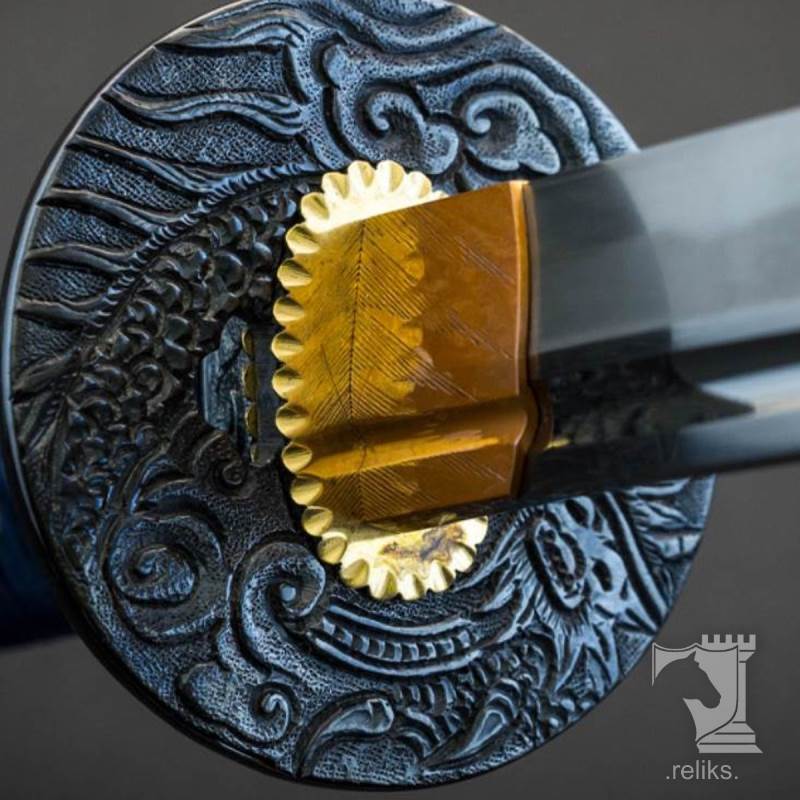
A properly fitted habaki must match the exact geometry of the blade
Why a Habaki Is Made for the Individual Blade
One of the most important things for collectors to understand is that a true habaki is not usually interchangeable. It is made for a specific blade. A properly fitted habaki must match the exact geometry at the base of that blade, including the dimensions of the ha-machi and mune-machi, the taper of the blade, the thickness of the mune, and the precise way the blade broadens as it moves away from the tang.
That custom fit is what allows the habaki to sit firmly and correctly. If it is too loose, the sword may not seat properly in the saya or may allow movement in the mounting. If it is too tight, it can bind, cause unnecessary wear, or place undesirable stress on the blade and fittings. This is why an old sword may wear many tsuba across its life, but a well-made habaki often feels married to the blade.
Some blades make this even more obvious. If the sword has a hi, the habaki may need to be carefully shaped to respect the groove’s position and transition near the base of the blade. This is one of the clearest visual reminders that a habaki is not a generic metal sleeve but a fitted component made to the individual sword.
A proper habaki is made to the blade itself. On swords with a hi, the shaping may reflect the exact geometry at the base of the blade, making true interchangeability unlikely.
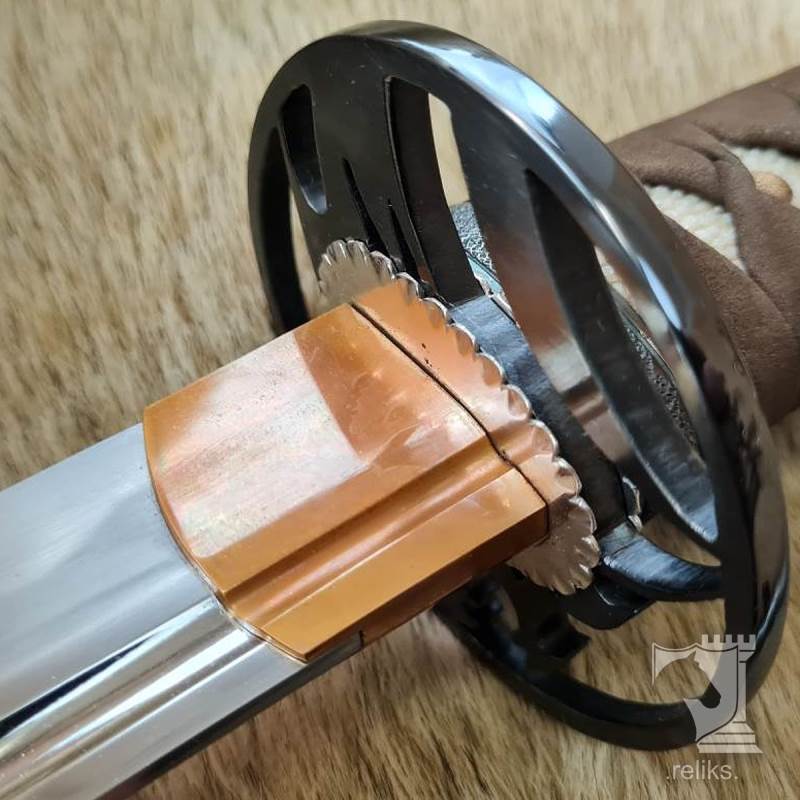
On swords with a hi, the shaping may reflect the exact geometry at the base of the blade
The Habaki as an Example of Japanese Sword Engineering
The Japanese sword is often admired for its blade, polish, and decorative fittings, but its mounting system is also an extraordinary piece of functional design. The habaki is one of the clearest examples of this. It performs several jobs at once while remaining visually restrained. It helps lock the blade into the saya, supports the pressure of the mounting stack, protects the critical transition area at the base of the blade, and allows the sword to be drawn and re-sheathed in a controlled and repeatable way.
That combination of duties makes the habaki one of the most mechanically sophisticated fittings on the sword. Its shape is not arbitrary. The slight wedge form helps create the right relationship with the koiguchi. Its fit against the machi must be exact. Its outer surfaces must interact correctly with the surrounding fittings. Every angle matters, even when the finished piece appears simple.
This is one reason the habaki deserves to be seen not as a decorative afterthought, but as a small masterpiece of applied metalwork. It is the point where the sword’s elegant theory becomes practical reality. It is where craftsmanship, handling, and mounting geometry meet.
Historical Origins and Early Development
Although the habaki is now inseparable from the identity of the Japanese sword, some early scholarship has suggested that the metal blade collar may have roots in continental influence. In older English-language studies of Japanese sword furniture, curators noted that the habaki appears to have been associated with sword forms shaped by Chinese influence, particularly in the era when Japan absorbed and adapted elements of court and military culture from the continent. In that view, the concept may not have originated as an entirely isolated Japanese development, even if it became uniquely refined in Japan over time.
Whether one prefers a strict continental origin or a broader story of Japanese adaptation, the wider point is clear: the habaki belongs to the long evolution of Japanese sword mounting rather than appearing suddenly in its final form. As Japanese swords developed from earlier straight and courtly forms into more specialised martial blades, the fittings evolved alongside them. The habaki became increasingly important as the mounting system matured and the relationship between blade, tsuba, seppa, tsuka, and saya became more sophisticated.
By the time the Japanese sword reached the forms most collectors readily recognise today, the habaki was no longer a simple metal collar. It had become a defining part of the sword’s functional identity. This is one of the reasons it feels so distinctly Japanese, even if its earliest conceptual roots may have been influenced by older continental models.
Materials, Finishes, and Quiet Luxury
Most habaki are appreciated first for their fit, but materials and surface treatment also reveal much about quality and intent. Copper has long been one of the most common and practical materials because it is workable, durable, and well suited to precise fitting. Brass is also seen, particularly on later or less elaborate examples, and can offer a striking contrast against polished steel. On finer examples, the surface may be textured, wrapped, foil-covered, or finished in ways that elevate the habaki without turning it into a showpiece.
This restraint is part of the habaki’s character. Unlike the tsuba, fuchi, kashira, or menuki, the habaki is rarely the place for overt narrative decoration. Its beauty tends to be quiet. A subtle texture, a refined metallic tone, a carefully finished edge, or a precious-metal surface treatment may be enough to signal quality. In high-level mountings, the habaki can show genuine luxury, but it usually does so with dignity rather than display.
For collectors, this makes the habaki especially rewarding. It is one of the few fittings whose refinement often reveals itself only after close inspection. A textured silver habaki, a carefully worked copper body, or a layered construction may say more about the taste of the owner and the quality of the mounting than a louder decorative flourish ever could.
Many habaki combine practical metalwork with subtle luxury. A functional copper body may be elevated by additional metalwork, layering, or refined surface treatment without losing its precise fit.
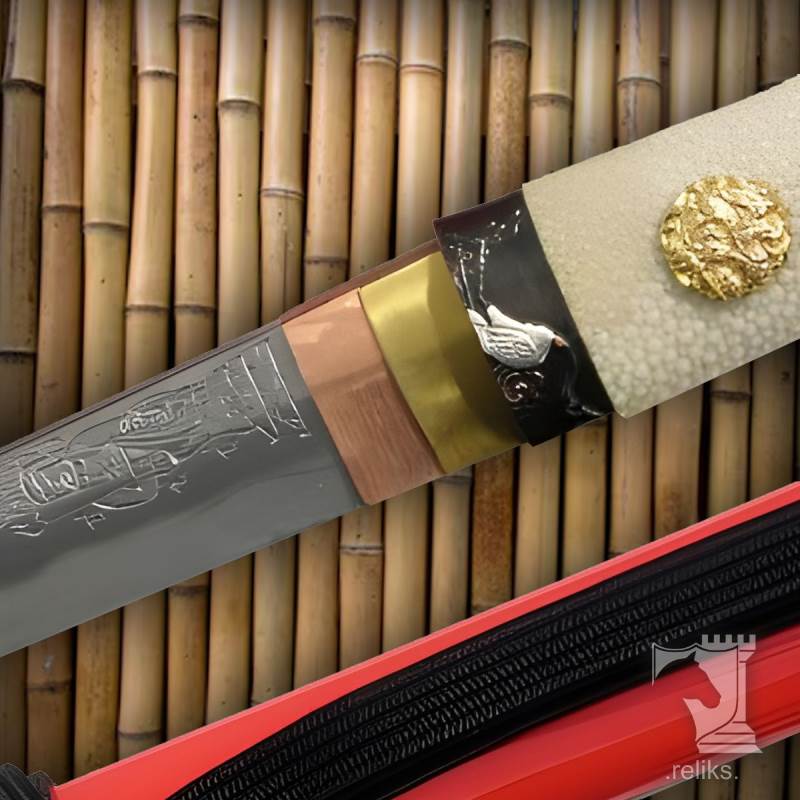
two-piece or niju habaki
Single and Double Habaki: A Quiet Sign of Refinement
Not all habaki are made in the same way. The most familiar form is the single-piece habaki, which is already a highly specialised fitting when made well. Collectors will also encounter the more elaborate double habaki, often called a two-piece or niju habaki. These are visually and structurally more complex, with an outer layer or secondary component that creates a more sophisticated appearance and often reflects a higher level of craftsmanship.
A double habaki can be one of the quiet signals that a sword was mounted with greater expense or care. It does not automatically mean the blade is older or finer, but it often suggests that the mounting was intended to be more refined. This is exactly the sort of detail that experienced collectors notice and newer enthusiasts often miss. In the world of Japanese swords, status is frequently expressed through subtlety, and the double habaki is a perfect example of that principle.
Because the habaki is not usually the most obvious focal point, a more elaborate example can be surprisingly striking once the eye learns to recognise it. For many collectors, the first time they truly notice a double habaki is the moment they begin to appreciate just how sophisticated even the “small” fittings of the Japanese sword can be.
A two-piece, or double habaki, is a more elaborate form often associated with higher-end mountings and a more refined presentation than the simpler single-piece style.
What an Old Habaki Can Tell You About a Sword’s Life
One of the most fascinating things about antique habaki is that they can preserve clues about a sword’s history. Japanese blades often outlived their original mountings by centuries. A blade might be remounted, re-polished, or re-fitted several times across generations. The current tsuba, saya, or tsuka may belong to a later chapter in the sword’s life than the blade itself. The habaki can sometimes be part of that story.
This is where collectors gain a deeper appreciation of the sword as a lived object rather than a frozen artefact. A 16th-century blade fitted with a 19th-century habaki is not automatically a mismatch or a flaw. In many cases, it reflects the very real historical fact that swords were maintained, updated, and re-mounted as they continued in use or passed through new ownership. Later fittings can form part of a sword’s authentic journey.
Because the habaki is custom-fitted, an older or later example may also preserve evidence of how the sword was mounted at a particular time. Its wear patterns, finish, and style may hint at previous koshirae, later aesthetic tastes, or the care taken during restoration. In that sense, the habaki is sometimes less a mere fitting than a witness. It can quietly record a chapter of the sword’s history that the rest of the mounting no longer fully reveals.
An older blade and a later habaki do not necessarily conflict. Japanese swords were frequently remounted across generations, and a 19th-century habaki on a 16th-century blade can reflect the sword’s authentic continued life.
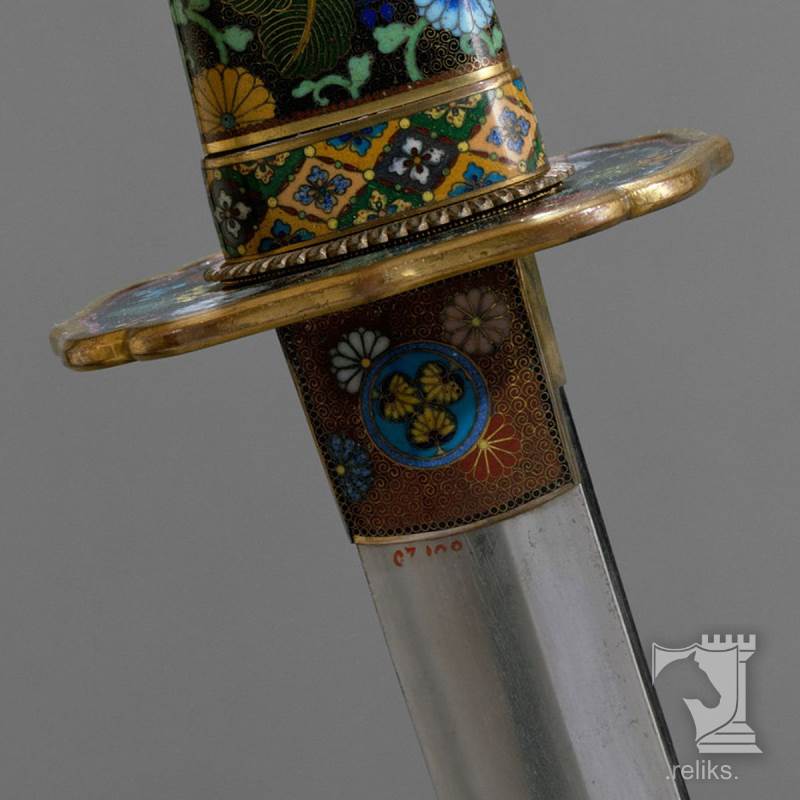
Elaborate 19th Century furniture mounted on a 16th Century blade*
Why Replacing a Habaki Is Never a Casual Decision
Because the habaki is so small, it is easy for newer collectors to underestimate the importance of replacing it correctly. A loose fit may tempt someone to assume the solution is simple: just make or buy another habaki. In reality, replacing a habaki is one of the most delicate fitting decisions in Japanese sword restoration and mounting.
A new habaki must be made for the blade itself, not chosen as a generic part. It must then work correctly with the koiguchi, the seppa thickness, the tsuba stack, and the overall pressure of the mounted assembly. Even if a replacement looks attractive, it can still make the sword feel wrong if it does not harmonise with the rest of the mounting. An improper replacement can lead to looseness, binding, poor seating, uneven pressure, or an obvious break in the sword’s historical character.
For antique swords in particular, preserving an older habaki can sometimes be preferable if it remains sound and functional. While there are certainly times when replacement is necessary, the decision should be made with respect for both fit and historical integrity. In Japanese swords, small parts often carry large consequences.
The Habaki and the Feel of the Sword
One of the least discussed but most satisfying aspects of a proper habaki is how much it influences the feel of the sword in the hand. The secure seating of the blade, the subtle resistance as it leaves the koiguchi, and the clean return during controlled re-sheathing all depend on the quality of the habaki fit. These are tactile details, but they are central to how a Japanese sword behaves as an object of craftsmanship rather than merely a display piece.
Collectors often learn this through experience rather than reading. A sword with a fine habaki and well-made saya simply feels coherent. It has a quiet mechanical confidence. The blade seats as though it belongs there because, in the best examples, it truly does. The sword is not merely assembled. It is integrated.
This is why the habaki deserves more attention in serious appreciation. It may not carry the visual drama of a sculpted tsuba or ornate menuki, but it is one of the places where the genius of the Japanese sword reveals itself most clearly. It is subtle, exacting, and indispensable.
Why the Habaki Deserves Collector Respect
For all the admiration given to blades, guards, and decorative fittings, the habaki remains one of the most overlooked components of the Japanese sword. That is a mistake worth correcting. The habaki is the quiet fitting that helps the sword function as a unified whole. It locks the blade into the saya, supports the mounting, reflects the skill of the craftsman, and can even preserve clues about the sword’s history across generations of use and remounting.
It is also one of the clearest examples of how Japanese sword furniture resists simple categories. The habaki is not purely decorative, but it can be elegant. It is not purely structural, but it is deeply tied to aesthetics. It is not always ancient in itself, yet it may still reveal part of an antique blade’s lived story. In a single small component, it combines engineering, connoisseurship, and restraint.
For collectors, that makes the habaki far more than a minor detail. It is one of the most quietly brilliant fittings on the Japanese sword. Once you learn to see it, you never look at a mounted blade the same way again.
Some photo's of Habaki on the katana we offer.
�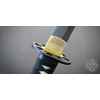 Designed as an evolution of the Practical Pro Katana, the Elite version was created for those who wanted more leverage and reach while keeping the straightforward working character of the original.
See more of the Practical Pro Elite Katana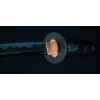 Copper habaki and seppa.
See more of the Modern Wakizashi - Bohi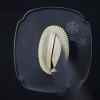 Silver seppa and habaki on the Dragon King Winter Sun Katana.
See more of the Winter Sun Samurai Sword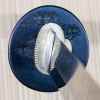 The silver habaki, menuki and seppa contrast against the black tsuka-ito and the white faux same (ray skin).
See more of the Raimie XL Katana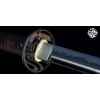 The habaki and seppa on the Hanwei Dragonfly Katana.
See more of the Hanwei Dragonfly Katana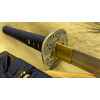 Brass habaki accents the silver seppa and fittings.
See more of the Water Dragon Katana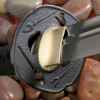 Tsuba design on the Cold Steel Warrior Nodachi with brass habaki.
See more of the Warrior Nodachi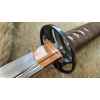 Beautiful habaki
See more of the Wolf Katana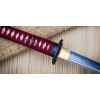 Contrasted by the crimson tsuka-ito (handle wrap), the white same (ray skin) on the wood core handle, the notched seppa (spacers), silver habaki (blade collar) and the cherry blossom menuki (handle ornaments), represent the only vivid aspects of this sobering piece.
See more of the Sakura Katana The 27” 1566 steel blade features a real hamon line with a copper habaki and seppa. The tsuka encapsulates the tang in textured G10 and dual pinned for a secure grip and is unremovable.
See more of the Modern Katana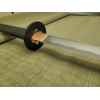 The 1566 forged steel blade features a real hamon line with a beautiful copper habaki and seppa.
See more of the Modern Katana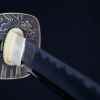 Silver habaki and seppa on the Kawanakajima Katana by Dragon King.
See more of the Kawanakajima Katana*Images marked with an asterisk are historical reference images sourced from public-use museum or public-domain collections, including The Metropolitan Museum of Art Open Access collection.